How to Spot Ghost Jobs on LinkedIn (and Reposted Roles)
TL;DR. A ghost job is a posting from a real employer that has no near-term plan to fill the role. Listings that look fake on LinkedIn fall into three different categories: a repost, a ghost job, or a scam. They have different causes and need different responses. Before you judge a listing by its age, know that LinkedIn's own documentation says a job post stays open until the poster closes it or it automatically closes after six months, so a stale-looking date is weak evidence on its own.
You've seen it. A role you applied to in March is back in your feed in August, looking freshly posted. The same company cycles the same title every few weeks. You keep applying and hearing nothing back.
The usual advice is a list of red flags, most of which boil down to treating an older posting as a fake one. That advice is wrong often enough to cost you good applications. Here's a more precise way to read a LinkedIn listing, built on what LinkedIn actually documents about how its job posts behave.
What is a ghost job?
A ghost job is a job advertisement posted by a real employer that has no intention of filling the role any time soon.
That definition matters because it excludes two things people lump in with it. A scam is fraud: a fake role, a fake company, or somebody impersonating a real employer. A repost can be nothing more than housekeeping, for reasons we'll get to. Only the middle category is a real employer knowingly spending your time.
| Reposted listing | Ghost job | Scam | |
|---|---|---|---|
| What it is | A closed job put back up, which LinkedIn treats as a new post | A real employer advertising a role it has no near-term plan to fill | Fraud: a fake role, a fake company, or impersonation of a real employer |
| Possible cause | Admin housekeeping, a changed brief, or a second opening | Building a resume pipeline, signalling growth, or hiring an internal candidate (per the CRS report below) | Harvesting your data or your money |
| Who posted it | The real employer | The real employer | Not who it claims to be |
| What it costs you | A little time | A lot of time | Your data or your money |
| What to do | Apply if it fits | Deprioritise the employer | Report it |
The distinction is worth holding onto, because the three call for different responses. A repost is often worth a second look. A ghost job tells you something about the employer rather than about your application. A scam is worth reporting.
Why do LinkedIn jobs keep getting reposted?
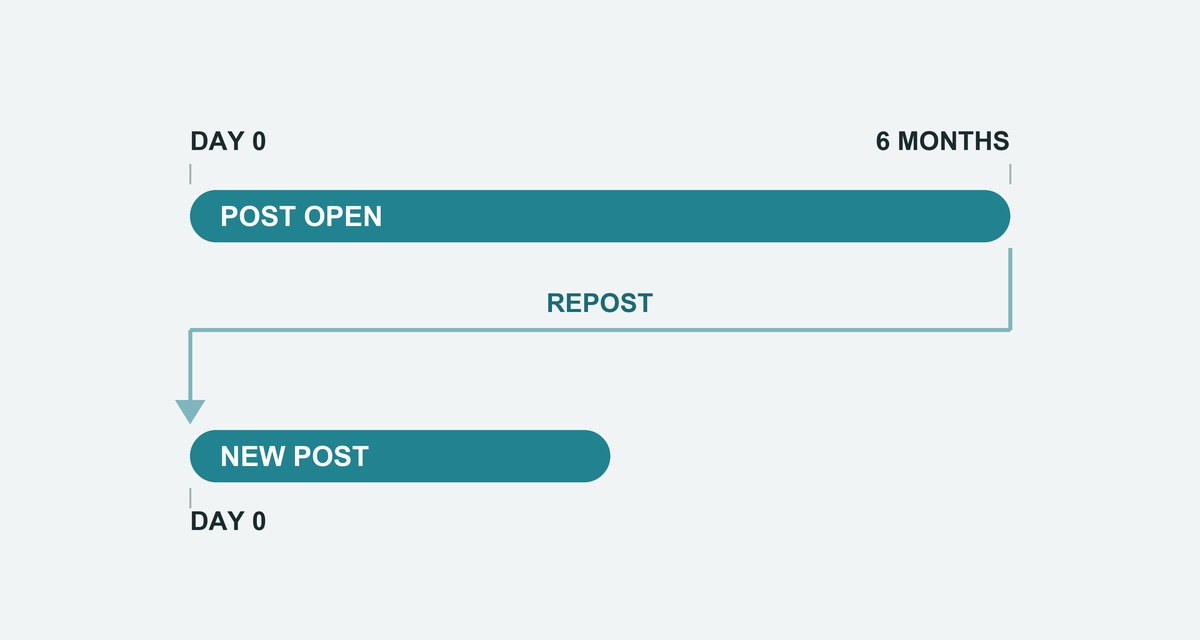
A job post can sit on LinkedIn for six months
LinkedIn's help page on the duration of a job posting states: "Job posts will stay open until you close the job manually or until the job automatically closes after 6 months. You'll continue to be billed until the job is closed. You can repost your job at any time after it closes."
Read that again, because it undoes the most repeated claim on this topic. A listing that has been up for two months has not passed some threshold of suspicion. It has simply not been closed yet, and it has up to six months before LinkedIn closes it for anyone.
That billing line is worth sitting with, though what follows is our inference and not something LinkedIn states. If an open post keeps costing money, an employer watching its spend has a reason to close roles once they're done. So one possible reading of a very old posting is that nobody got around to closing it, which says more about the company's admin than about whether it wants to hire.
Reposting a closed job creates a new post
The same page says: "If you decide to repost a closed job, it'll be treated as a new job post. If this happens, all previously gathered applicant information will be associated with the closed job post."
Two things follow, and we'd call the first our reading rather than LinkedIn's claim: a role you saw six weeks ago can reappear looking new, because as far as the system is concerned it is new. The second comes straight from the documentation. If you applied to the original posting, your application information stays associated with the closed post rather than moving across to the new one. That is the mechanical reason applying again to a genuinely reposted role can be worth it.
Why do employers post jobs they don't plan to fill?
The Congressional Research Service looked at this in its April 2025 In Focus report on ghost job postings. It lists several reasons employers post roles they aren't filling: to "evaluate the potential pool of candidates for future job postings or collect resumes for hiring at a later time"; to "suggest they are growing either to signal to existing employees that they are replaceable or that their workload may soon be more widely shared, or to attract potential investors"; to "demonstrate they have recruited a diverse pool of applicants, even though they plan to hire an internal candidate"; or to "look for extraordinary potential employees."
The report also notes that in some cases "employers may interview applicants when they have no intention of hiring anyone."
Plenty of ghost listings aren't deliberate at all
This is the part the red-flag listicles skip. The same report states plainly that "some ghost job postings are not deliberate," and gives causes that have nothing to do with bad faith.
Circumstances change and a budgeted role evaporates. Job boards copy postings automatically, so a role can live on elsewhere after the employer takes it down: as the report puts it, "if an employer hires someone for a position, the employer may remove the posting from the website where it was originally posted, not realizing it was copied elsewhere." Staffing agencies "may also invent and post job openings to show employers they could recruit talented people."
None of that makes the wasted application feel better. It does change what you should do about it, which is to spend less energy being angry and more energy filtering.
How common are ghost jobs, really?
Here is where most articles quote a number and move on. The number deserves more care than that.
Greenhouse, a hiring software company, publishes the most-cited figure. Its 2024 State of Job Hunting report pairs a survey of 2,500 workers across the US, UK and Germany with data from its own hiring platform. The figure everyone quotes comes from the platform side: "In any given quarter, 18–22% of the jobs posted on the Greenhouse platform are classified as ghost jobs." Note the scope. That is jobs posted on Greenhouse's own platform, classified by Greenhouse, not a measurement of the whole market.
A separate estimate comes from a 2024 preprint by Hunter Ng, Why is it so hard to find a job now? Enter Ghost Jobs. Using Glassdoor data and a language-model classifier, it finds that "up to 21% of job ads may be ghost jobs, and this is particularly prevalent in specialized industries and in larger firms." It's a preprint, the figure is an upper bound, and the data is Glassdoor rather than LinkedIn.
Your instinct isn't wrong, either. On the survey side, the same report says "three in five candidates say they suspect they've encountered a ghost job."
Now the caveat nobody quotes. The Congressional Research Service is blunt: "There are no official statistics on the magnitude of ghost jobs." It goes further, pointing out that "the firms behind these studies market hiring-related services, including job posting verification tools" and "have released varying levels of information regarding the methodologies of the surveys and analyses, making it difficult to assess the quality of ghost job prevalence estimates."
Both published estimates land near one in five, and neither is an official measurement. That's the honest version, and it's still enough to justify checking before you apply.
How to spot ghost jobs on LinkedIn in about a minute
Checking is normal now. LinkedIn's own 2026 Job Search Safety Pulse reports that "nearly three-quarters (72%) of professionals surveyed say they stop to think about the legitimacy of a role at least sometimes before applying, including 29% who say they always do," and that "57% of professionals say they are more likely to question whether a job is a scam than they were a year ago, compared with just 11% who say they are less likely to do so." That report is about scams specifically, which are a different category from ghost jobs, but the behaviour it describes is the right habit either way. The cheapest place to build it in is the triage step of a repeatable LinkedIn job search routine, before you save anything.
The red flags that actually mean something
Here's the minute.
Read the posting date, then watch it. LinkedIn's filter and sort documentation says results show jobs "from any time" by default, and that you can narrow to jobs "posted within the last 24 hours, the past week, and the past month." Narrow it. Then, as a heuristic rather than a documented rule: if the same title reappears with a fresh date a few weeks later, that pattern fits a repost cycle rather than one long-running ad.
Check the company's own careers site. LinkedIn's research reports that "57% search for the company or role online" and "47% check whether the job appears on the company's own careers site." The careers-site version is the more specific of the two, and it's the one that catches the copied-posting case described above. If the role isn't there, it may have been filled, mirrored by a job board, or never real.
Look at the company's LinkedIn page. The same report puts this at "32% review the company's LinkedIn Page." What you do with it is judgement: recent posts, people who list a recent start date, and a visibly active recruiter are all consistent with a company that's hiring, though none of them proves this particular role is open.
Read the posting like an editor. This one is our heuristic rather than anything documented: a posting written for a specific seat tends to name the team, the scope, and who you'd report to, while a posting written to collect resumes has no single seat to describe and stays general. Treat it as a hint, not proof.
Ask, and stay on LinkedIn to do it. Message the recruiter and ask whether the role is currently open. If someone pushes you to a personal chat app, treat that as a scam signal: LinkedIn reports that "90% of reported scam messages involve moving to private messaging, where LinkedIn's safety tools can't protect you and accounts are far more difficult to verify."
Make a decision and stop revisiting it. If a company keeps posting roles you can't verify, the answer isn't to keep evaluating each one. It's to stop seeing them, which is what excluding that company from your LinkedIn job search does.
What to do when the same company keeps reposting
Attention is the thing you're actually short of. Every re-evaluation of the same suspicious employer costs you some, and LinkedIn will keep serving them: its documentation notes that "you may see additional suggestions based on your search query and preferences," and that result order is shaped by "your search activity on LinkedIn" and "other members who have made similar searches." There's a ceiling on what you can work through in any case, since LinkedIn states that "any job search performed on LinkedIn will render up to 1,000 results by default."
So make the judgement once, then make it stick.
That's the part a filter handles well. JobSieve is a free, open-source Chrome extension that filters your LinkedIn job search. Add an employer to the company blacklist and its listings stop appearing. Put your deal-breaker terms in the keyword blocklist and those drop out too. Put the skills you want in the whitelist and matching roles get highlighted instead of buried. It's MIT-licensed, the source is on GitHub, it runs entirely in your browser with no account, and its permissions are scoped to LinkedIn job pages.
To be clear about what it does and doesn't do: JobSieve doesn't detect ghost jobs and doesn't de-duplicate reposts. Judging an employer's intent from a posting is a call you make, not something an extension can make for you. What JobSieve does is hold that decision in place, filtering the companies and terms you've chosen to exclude so a company you've written off stops costing you attention every week.
The same approach works on the rest of the noise. If you want the full setup, we've written up a repeatable way to filter your LinkedIn jobs feed, plus specifics on how to hide promoted jobs on LinkedIn and how to find remote roles without wrong-location noise.
How to report a misleading job on LinkedIn
LinkedIn documents this. Its help page on reporting jobs says: "If you come across a job on LinkedIn that you find to be inappropriate, broken, or incorrect, you can flag the job to be removed with your feedback."
Open the job, use the report option, and pick the category that fits. The documented options include "I think it's a scam, phishing or malware," "I think it's promotional or spam," and "I think it's an illegal good or service," alongside paths for discriminatory or offensive content and for postings that are broken or incorrect.
The categories LinkedIn lists cover fraud, spam, illegal content, discrimination, and listings that are broken or incorrect. Age isn't among them, so reporting is the right tool for a scam or a broken listing rather than for a company with untidy job admin.
Frequently asked questions
Why do LinkedIn jobs keep getting reposted? Because reposting is easy. LinkedIn documents that you "can repost your job at any time after it closes" and that if you repost a closed job, "it'll be treated as a new job post." Any individual employer's reason isn't visible from the outside, which is why a company's posting history tells you more than a single listing does.
How long does a job posting stay up on LinkedIn? LinkedIn's documentation says job posts "stay open until you close the job manually or until the job automatically closes after 6 months."
Is a reposted job worth applying to? Often, yes. LinkedIn documents that a repost is treated as a new job post and that previously gathered applicant information stays associated with the closed post. So an earlier application doesn't carry over to the new listing. If the role still fits, applying to the new post is reasonable.
What percentage of job postings are ghost jobs? Estimates cluster around one in five, but read them carefully. Greenhouse reports that 18–22% of jobs posted on its own platform in a given quarter are classified as ghost jobs, and a 2024 preprint using Glassdoor data estimates up to 21% of ads may be ghost jobs. The Congressional Research Service notes there are no official statistics on this, and that the firms publishing such estimates also sell hiring services.
Is it illegal to post a ghost job? This varies by jurisdiction. The Congressional Research Service's In Focus report on ghost job postings surveys the existing laws relevant to ghost jobs and the related legislative proposals. We're not the right source for legal guidance, so check your local rules or a qualified adviser.
How do I report a ghost job on LinkedIn? Open the job posting and use LinkedIn's report option, which covers scams, spam, and postings that are broken or incorrect. A stale posting on its own generally isn't a violation.
The short version
Learning to spot ghost jobs on LinkedIn isn't about reading an employer's mind. It's about telling a repost from a ghost job from a scam, checking a listing in a minute, and then declining to spend that minute again on an employer who has already shown you how they operate.
Found a role that survives the check? JobMason tailors your resume, cover letter, hiring-manager email, and application Q&A to that specific posting. JobSieve keeps the listings you've ruled out from coming back; JobMason helps with the ones you decide to pursue.
Frequently asked questions
- Why do LinkedIn jobs keep getting reposted?
- Because reposting is easy. LinkedIn documents that you can repost a job at any time after it closes, and that a reposted closed job is treated as a new job post. An individual employer's reason isn't visible from the outside, which is why a company's posting history tells you more than a single listing does.
- How long does a job posting stay up on LinkedIn?
- LinkedIn's documentation says job posts stay open until you close the job manually or until the job automatically closes after 6 months.
- Is a reposted job worth applying to?
- Often, yes. LinkedIn documents that a repost is treated as a new job post and that previously gathered applicant information stays associated with the closed post, so an earlier application doesn't carry over to the new listing. If the role still fits, applying to the new post is reasonable.
- What percentage of job postings are ghost jobs?
- Estimates cluster around one in five, but read them carefully. Greenhouse reports that 18-22% of jobs posted on its own platform in a given quarter are classified as ghost jobs, and a 2024 preprint using Glassdoor data estimates up to 21% of ads may be ghost jobs. The Congressional Research Service notes there are no official statistics on this, and that the firms publishing such estimates also sell hiring services.
- Is it illegal to post a ghost job?
- This varies by jurisdiction. The Congressional Research Service's In Focus report on ghost job postings surveys the existing laws relevant to ghost jobs and the related legislative proposals. We are not the right source for legal guidance, so check your local rules or a qualified adviser.
- How do I report a ghost job on LinkedIn?
- Open the job posting and use LinkedIn's report option, which covers scams, spam, and postings that are broken or incorrect. A stale posting on its own generally isn't a violation.
Sources
- LinkedIn: job posts stay open until closed manually or until they automatically close after 6 months, and a reposted closed job is treated as a new job post with previously gathered applicant information staying on the closed post.
- LinkedIn: the Date posted filter offers the last 24 hours, the past week and the past month; searches return up to 1,000 results by default; results may include additional suggestions and are ordered using your search activity.
- LinkedIn: how to report a job that is inappropriate, broken or incorrect, and the reporting categories available.
- Congressional Research Service, Ghost Job Postings (April 2025): there are no official statistics on the magnitude of ghost jobs; the documented deliberate and non-deliberate reasons postings persist; and the caveat that the firms behind prevalence studies market hiring-related services.
- Greenhouse 2024 State of Job Hunting report, which pairs a survey of 2,500 workers across the US, UK and Germany with Greenhouse platform data. From the platform data: 18-22% of jobs posted on the Greenhouse platform in a given quarter are classified as ghost jobs. From the survey: three in five candidates suspect they have encountered a ghost job.
- Hunter Ng, Why is it so hard to find a job now? Enter Ghost Jobs (2024 preprint): using Glassdoor data and an LLM-BERT technique, up to 21% of job ads may be ghost jobs.
- LinkedIn Job Search Safety Pulse 2026: 72% of professionals stop to think about a role's legitimacy at least sometimes; 57% search the company or role online and 47% check the company's own careers site; 90% of reported scam messages involve moving to private messaging.
- JobSieve's repository: the live filters are a company blacklist, location exclusion, keyword blocklist and keyword whitelist highlighting; the licence is MIT; the manifest requests only storage and activeTab, scoped to LinkedIn job pages.